

Agriculture

With over 59,000 dairy cows in Fond du Lac county, ensuring high-quality forage production is critical to sustaining milk production and farm profitability. Helping growers meet forage quality goals for their farm means lower outside feed costs, healthier cows and improved sustainability of that farm. Furthermore, given the key role Spanish-speaking workers play, providing bilingual information is essential. Through training, newsletters, webinars, workshops, and other resources, Extension’s Agriculture team ensures that feasible, science-based practices are accessible to farmers, managers and workers. This approach helps improve communication, increase efficiency, and enhance the overall performance of local dairy operations.
Crops | Liz Gartman, Regional Crops Educator
An educational program for dairy producers, crop consultants and livestock nutritionists where attendees learned about strategies for improving corn silage digestibility, opportunities for using short corn in crop rotations and risk management for corn and soybeans to provide quality forage to support milk production and total farm profitability.
- The Fond du Lac Forage Council reached out to the regional crop and dairy educators to provide a forage-focused program for their members. The Council provided timely topic ideas to the educators to consider when determining the program.
- The educators reached out to several speakers to highlight the topics provided by the Forage Council. Dr. Luiz Ferraretto was willing to discuss his work with corn silage digestibility, Liz Gartman shared an update on the use of Short Corn in dairy crop rotations, John Heinberg from Total Farm Marketing provided a grain market and risk management update, and Manuel Pena discussed Highly Pathogenic Avian Influenza as well as providing an update on dairy programming available to producers.
- Twenty individuals representing a number of dairy farms, feed companies and agronomy consulting companies attended the meeting. Attendees commented that they would be interested in implementing different chopping heights when harvesting corn silage, improving NDF digestibility, and implementing grain marketing strategies to manage risk.
A regional agriculture newsletter for Fond du Lac, Sheboygan, Washington and Ozaukee County agriculture producers, industry representatives and agency staff that provides timely crop production updates, dairy and farm management resources and upcoming agriculture events. The goal is to create awareness of Extension programming and research in the region and maintain a connection between UW and the ag community.
- Crop, dairy and livestock producers make key management decisions every day based on challenges related to markets, weather and farm goals. It is important for them to have access to up-to-date information and opportunities to help them choose production methods that help them achieve their goals.
- The Regional Extension Ag Updates newsletter is prepared and e-mailed to approximately 850 ag producers, agency staff and agribusiness consultants that support farmers. In the winter months, the newsletter is sent monthly, with issues every two weeks during the crop production months. This newsletter shares field trial opportunities, timely management updates and tools to support production decisions, along with UW Extension and partner event opportunities.
- This newsletter consistently has a 40% open rate and one recipient shared the importance of having upcoming local and statewide events listed in one place. It further has become a great partnership tool between Extension and local producer-led watershed groups, land and water departments and state agencies. This effort creates a greater awareness of resources available to support their farm production goals.
Dairy I Manuel Peña, Regional Dairy Educator
A webinar for dairy farmers and ag professionals that focused on an in-depth look at high-oleic soybeans and their role in both crop production and dairy nutrition. The purpose of this webinar was to provide participants with unbiased,
evidence-based research about high oleic soybeans.
- High oleic soybeans are a new variety to crop producers. However, there are differences in growing, performance, and management of these beans. There are also differences in how we feed these beans based on their fatty acid profile. To address this gap, a webinar was organized for dairy farmers and ag professionals to talk about the difference in growing and feeding the beans. A webinar brought in both Conley, Goldsmith, and Lippert as speakers to address the agronomics of growing and feeding of high oleic soybeans.
A bilingual article written for dairy farmers and industry professionals where we discussed the importance and impact of Body Condition Score (BCS). The purpose of the article is to help farmers measure it on farms to help prevent digestible disorders at different stages of production, and to increase efficiency of the cows.
- Fresh cow issues cost producers approximately $8 billion each year in the United States, representing a significant economic burden on the dairy industry. A substantial portion of these problems can be traced back to the cow’s body condition at the time of calving, which plays a crucial role in determining her health, productivity, and ability to transition smoothly into lactation. Cows that are either too thin or too fat at calving are more susceptible to a range of metabolic disorders, such as ketosis, milk fever, and displaced abomasum, all of which can compromise milk production, increase veterinary costs, and even lead to early culling. Proper management of body condition during the dry period and close-up phase is therefore essential to minimizing these fresh cow issues and improving both animal welfare and farm profitability.
Human Development and Relationships

UW Extension Fond du Lac County Extension Human Development & Relationships provides programs that promote housing stability, support youth, and strengthen families. The Rent Smart program helps families gain the knowledge and skills needed to secure and maintain housing, while Adulting 101: Keys to Independence prepares older youth aging out of foster care with life skills in finance, careers, and communication. The program also offers Co-Parenting Education to improve communication between co-parents, address the impact of divorce on children, and build strategies for resilience. In addition, Extension supports helping professionals by providing financial education, professional development, and connections to financial resources.
Carol Bralich, Human Development and Relationships Educator
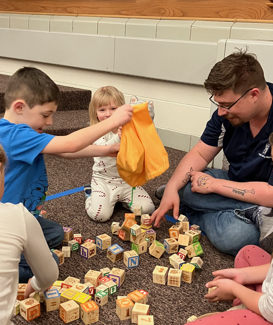
The Head Start Assistant Director of Health and Family Services approached Carol to facilitate an interactive and educational activity for one of their fatherhood initiative events. The Block Party provides a structured, fun activity for dads to practice interactive conversations with their children and spend one-on-one time together. Carol coordinated and facilitated the Block Party event with Head Start. Five stations with different types of blocks were organized in a circle around the room. Each station had a conversation prompt or open-ended questions that both the Head Start staff and the dads could use to encourage their child to talk about what they were creating with the blocks. Each station also provided visual prompts as to how playing with blocks is related to science, reading skills, physical skills, pre-reading skills and social skills. The dads and children rotated to a new station, moving clockwise following arrows on the floor.
The dads received a Block Party booklet to take home to continue to practice and help their children build on the concepts introduced at the Block Party. The structured play space for the Block Party provided important and focused time together for the dads and their child/children. Dads were role-modeling by playing on the floor, encouraging their children to be imaginative, and supporting them when they were struggling with the blocks. They were also using the open-ended talking tips to help their children explain and verbalize what they were doing with the blocks. Children need experiences to be stimulating, fun, and interactive. Adults can guide children’s early learning experiences and use blocks as a tool to support their development. Playing with blocks can provide experiences where children learn math and science, new words and pre-reading skills, social skills and physical skills.
Positive Youth Development

UW Extension Fond du Lac County youth grow into engaged, empathetic leaders through hands-on learning and meaningful service. Our 4-H program offers enriching experiences—from STEM challenges and animal science to creative arts—that spark curiosity and build confidence. Signature events like Family Learning Day and Summer Day Camps provide opportunities for exploration and skill-building, while service projects such as food drives and care kit assembly foster civic responsibility and community connection. In partnership with local schools and the Boys & Girls Club, we also offer after-school clubs that create inclusive spaces for growth and belonging.
Tracy Keifenheim, 4-H Program Educator
A multi‐county team of educators collaborated to plan the annual Winter Leadership Camp for youth in grades 7 and
above. The camp is designed to provide high‐quality leadership and personal development experiences, aligning with the priority of offering meaningful educational opportunities for older youth. Planning efforts included coordinated
development of the schedule, theme, promotion, and program activities, with youth contributing to select planning
components. Due to extreme and unsafe wind chill conditions, the camp was cancelled for its originally scheduled dates. Rescheduling efforts for February are currently underway. The program aims to enhance participants’ leadership skills, expand peer connections, and increase awareness of leadership pathways within 4‐H. This year’s curriculum also emphasizes practical life skills such as financial literacy, sewing, first aid, bicycle repair, and written communication.
The 6‐week STEM: CSI program engaged 4th and 5th-grade youth in hands-on, crime‐scene‐themed science activities designed to spark curiosity, strengthen problem‐solving skills, and introduce foundational forensic techniques. In response to identified program needs, Misty worked closely with partners—including the Chegwin Boys and Girls Club—to plan meaningful 4‐H after‐school offerings for the 2025–26 school year, aligning activities with targeted outcomes such as helping youth discover their sparks, build knowledge in interest areas, and grow communication, empathy, teamwork, and problem‐solving skills. The program successfully connected scientific concepts to real-world experiences, and feedback showed a strong impact: all participants reported trying something new, enjoying the activities, exploring interests, and feeling excited to share what they learned.
The University of Wisconsin–Madison Division of Extension provides equal opportunities in employment and programming in compliance with state and federal law.