

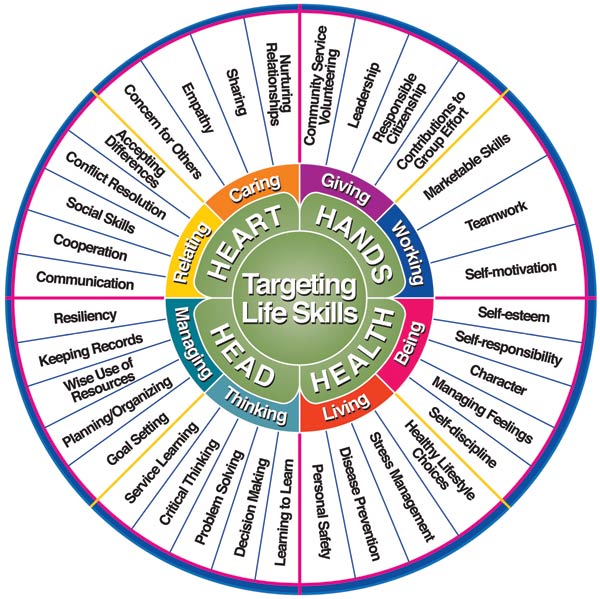
Life skills are tools people use to deal with daily situations, make important decisions, and enhance their quality of life. Youth gain life skills by doing activities that help them practice these life skills in order to use them later on in other activities. Gaining “concrete skills”, also known as regular skills, is a little different, as youth simply increase their ability to do one specific task that may not apply to other activities. For example, learning how to cut meat and vegetables is a
concrete skill, but learning how to cut them in a way that creates the least amount of waste improves the life skill of “wise use of resources” which may be used in other, future situations. Another concrete skill might be learning how corn crops are planted and raised, and through that concrete skill, youth may grow the life skill of self-discipline as they work and care for the crop throughout the season.
Iowa State University created the Life Skills Model, based on research, as a visual way to show how many life skills can be strengthened through 4-H activities. The skills are organized by the four H’s of the 4-H Clover, which are Head, Heart, Hands, and Health.
Why are life skills important?
Strengthening life skills in youth creates a better chance that they will be successful and healthier later in life. Although concrete skills are important to build, life skills are able to be used in many parts of life and in many different situations that youth will encounter.