

Agriculture

With over 59,000 dairy cows in Fond du Lac county, ensuring high-quality forage production is critical to sustaining milk production and farm profitability. Helping growers meet forage quality goals for their farm means lower outside feed costs, healthier cows and improved sustainability of that farm. Furthermore, given the key role Spanish-speaking workers play, providing bilingual information is essential. Through training, newsletters, webinars, workshops, and other resources, Extension’s Agriculture team ensures that feasible, science-based practices are accessible to farmers, managers and workers. This approach helps improve communication, increase efficiency, and enhance the overall performance of local dairy operations.
Crops | Liz Gartman, Regional Crops Educator
Planning for a four-session, 2026 Focus on Forage webinar series for livestock producers, forage growers and agriculture consultants. The goal of the series is to provide timely forage management guidance to improve forage quality and meet farm productivity goals.
- Dairy and livestock producers require high quality forages to meet the animal production goals on their farms. Using a quality forage base reduces feed inputs and leads to improved animal health, milk production and growth. There are many opportunities for forage growers to increase forage dry matter production and quality while optimizing input costs, and this series aims to provide research based solutions to these producers.
- The Focus on Forage planning team identified topics and speakers that address the key management challenges and opportunities that exist for forage growers. Ongoing planning will result in four scheduled webinars in February 2026 that will each address a specific topic area related to forage production.
A series of 3 in person and 1 virtual Crops & Soils Program update meetings for crop and forage growers, consultants,
agronomists, students and agency staff where participants learned about recent research results and crop management practices learned during the 2026 growing season. Extension specialists shared talks related to nutrient management, forage and grain production and pest management with the goal that attendees can make more informed crop management decisions to improve farm resilience and profitability.
- Each growing season is characterized by specific economic, weather and growing conditions that challenge the decision making of crop growers. The end of the season provides a unique opportunity to debrief the season and discuss how response to these challenges worked out for farmers, and what lessons might be learned for future years.
- The event hosted the following number of participants at each site: Eau Claire: 44; Monroe: 21; Appleton: 31; and Zoom/Virtual: 81.
- Evaluation results reflected that 79% of respondents would be able to use what they learned to improve management decision for their farm or their client’s farms; 75% of respondents plan to implement strategies discussed in the next year; one responded answered the speakers “did a good job researching and thinking of most of the questions consultants & farmers would have” while another shared “the event provides an opportunity to interact with their peers.”
Dairy I Manuel Peña, Regional Dairy Educator
A meeting for dairy farm managers and their workforce to present the progress of the program we are developing for
their use to gather their feedback and insights to help finalize and enhance the program’s design and effectiveness.
- On dairy farms, heavy machinery such as tractors and skid loaders plays a vital role in daily operations, but it also poses significant safety risks. According to the University of Wisconsin Madison’s Agricultural Safety & Health Program, tractors have caused the majority of non‑highway farm fatalities in Wisconsin recently, and machinery is frequently involved in entanglement, crushing and other serious injuries. We are developing a training toolbox that farms can access at any time to support workforce education. These meetings are designed to gather feedback from farm managers and workers, helping us refine the program to ensure it’s practical, effective, and tailored to the needs of those who will use it.
A statewide program promoting humane dairy cow-handling practices for dairy cow handlers where the participants will
learn to be aware of their own beliefs about working with cows, which affect how they interact with them. They will also
learn how to form or maintain good habits, which will make the cows easier to handle and their job smoother.
- A growing number of people worldwide are interested in how animals such as dairy cattle are treated on farms. What dairy handlers do in their daily job matters to people both inside and outside of the farm. To meet this need, we are creating a bilingual learning program designed to enhance dairy handlers’ attitudes and interactions with the cows they work with. The initiative will begin with a pilot phase, which will be carefully refined through feedback and observation. Once finalized, it will be implemented on selected farms and evaluated to measure its effectiveness in promoting positive handling practices and enhancing animal welfare.
Community Development
UW Extension Fond du Lac County Community Development provides educational programming through capacity-building workshops such as Fund Development and Fundraising, facilitates community conversations that spark collaboration and action on emerging needs, and supports organizational leaders with 1:1 coaching, professional development, and connections to resources.
Noah Reif, Community Development Educator
A workshop for participants in the Wisconsin Library Association’s Leadership Development Institute guiding them
through the importance of building trust as a leadership skill. The objectives of the workshop were to deepen
understanding and learn how to identify different types of trust, how to assess existing levels of trust, and to reflect on
how they can incorporate trust building into their leadership development.
- The Wisconsin Library Association (WLA) organizes a Leadership Development Institute for its members. Extension worked with WLA to redesign, deliver, and evaluate the Institute in 2023. When they decided to offer the Institute again, WLA reached out to Extension to deliver similar content for the new cohort of participants. Extension worked with WLA to identify specific leadership development topics to be included in the Institute. A workshop on Building trust was delivered on December 3, 2025 for the WLA Leadership Development Institute and attended by 17 library leaders from around the state. Participants were asked to evaluate the session on three criteria: knowledge gained, the usefulness of the knowledge gained, and overall facilitation. Each criteria would be scored on a scale of 1 to 5, with one being the lowest possible score and five being the highest possible. Evaluation from 13 participants shows that library leaders feel they gained new knowledge and skills to build trust (4.9 of 5), that the workshop content will be useful for library leaders in their roles (4.9 out of 5) and that the educator’s facilitation of the workshop was exceptional (5 out of 5).
Support and advising for a coalition of nonprofit and private organizations regarding the design of programming for local nonprofits. The goal of the coalition is to provide programming that builds organizational capacity and increases trust among smaller nonprofits in Fond du Lac County.
- Needs assessments conducted by the educator and feedback gathered from local nonprofit leaders have identified the need to build organizational capacity, particularly for the volunteer board members. Additionally, nonprofit organizations have named collaboration and networking with other nonprofits as a critical need. The educator will advise the coalition, known as the Fond du Lac Nonprofit Initiative, on program design that meets the stated goals of the initiative. The educator will also attend meetings and provide facilitation services as requested by the group.
Human Development and Relationships

UW Extension Fond du Lac County Extension Human Development & Relationships provides programs that promote housing stability, support youth, and strengthen families. The Rent Smart program helps families gain the knowledge and skills needed to secure and maintain housing, while Adulting 101: Keys to Independence prepares older youth aging out of foster care with life skills in finance, careers, and communication. The program also offers Co-Parenting Education to improve communication between co-parents, address the impact of divorce on children, and build strategies for resilience. In addition, Extension supports helping professionals by providing financial education, professional development, and connections to financial resources.
Carol Bralich, Human Development and Relationships Educator
The average American tenant is “cost-burdened” (paying 30% or more of income toward rent). According to the 2022 State of Home Affordability in Wisconsin report, 65% of renters in the state pay more than 30% of their income on housing and 37% of renters spend more than 50%/month (among renters who earn less than $50,000/year). The report also indicates that many renters don’t earn enough to afford the average rental unit. The lack of affordable housing availability makes it difficult for a community to attract and retain workers.
Extension’s Rent Smart course provides participants with knowledge and skills that can help them find and keep safe and affordable housing that meets their needs. The six-session course features lessons on determining what they can afford to pay for rent, checking out the rental property and landlord, application process, understanding who’s responsible for maintenance, repair, and care, communication skills and rental agreements.
There were 52 total Rent Smart participants at St. Katharine Drexel Shelter who received a completion certificate in 2025. Rent Smart is designed to help participants find and keep safe, affordable, and quality rental housing. Among Rent Smart survey respondents in 2025, 100% of respondents said this class will or might help me keep housing in the future. When residents have reliable housing that they can afford and landlords have responsible tenants, communities benefit through having a stable workforce. When asked what they would do differently moving forward after the Rent Smart class, one participant stated, “Building a better relationship with my landlord.”
There were 34 total Rent Smart participants at the Beacon House who received a completion certificate in 2025. Among Rent Smart survey respondents in January 2025, 100% of respondents said this class will or might help me keep housing in the future. One participant stated, ” Thank you. This certificate will help me greatly in the future.” Another participant wrote, ” Never rented before, so very excited to have all this information.”
Positive Youth Development

UW Extension Fond du Lac County youth grow into engaged, empathetic leaders through hands-on learning and meaningful service. Our 4-H program offers enriching experiences—from STEM challenges and animal science to creative arts—that spark curiosity and build confidence. Signature events like Family Learning Day and Summer Day Camps provide opportunities for exploration and skill-building, while service projects such as food drives and care kit assembly foster civic responsibility and community connection. In partnership with local schools and the Boys & Girls Club, we also offer after-school clubs that create inclusive spaces for growth and belonging.
Tracy Keifenheim, 4-H Program Educator
A Market Livestock Judging Information Night was held to introduce youth to the fundamentals of evaluating cattle, sheep, and swine for market readiness while exploring opportunities to join a judging team. This program addressed two key needs: low Youth Sparks scores in the county, which indicate a need for activities that ignite passion and engagement, and the demand for educational opportunities within the highly enrolled Market Livestock project area. A motivated youth volunteer organized the session, which provided a crash course in livestock judging, gauged interest in forming a team, and sought an adult volunteer to assist with coaching. Participants practiced evaluating animals, earned Market Livestock Education points, and learned how team involvement can enhance their skills. Several youth expressed interest in joining a team, and practices will begin in the new year with the goal of representing Fond du Lac County at contests. This initiative not only strengthens decision-making, animal science, and communication skills but also fosters leadership and teamwork—preparing youth for success in agriculture and beyond.
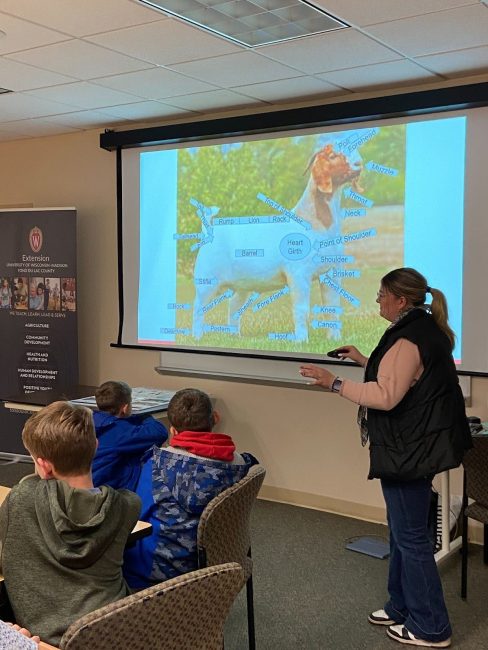
Misty Jimenez, 4-H Associate Educator, offered a six-week Fun With Science series for three groups of middle and high school students in the North Fond du Lac School District, designed to spark curiosity and build knowledge through hands-on experiments that demonstrated science in action. Based on strong interest in science activities from the previous school year, this program was developed to build on student enthusiasm and provide engaging, real-world applications of scientific concepts. Initially introduced as a classroom partnership, the program expanded to include additional students, many of whom were returning participants. Each week, students expressed excitement with comments like, “Yay, it’s 4-H!” and “This is my favorite class.” A feedback survey from one group showed unanimous agreement that participants tried something new, enjoyed the activities, explored topics they liked, and observed adults listening to youth during group decision-making—highlighting the program’s success in fostering both learning and positive youth-adult partnerships.
The University of Wisconsin–Madison Division of Extension provides equal opportunities in employment and programming in compliance with state and federal law.